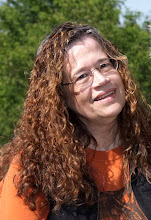
Today's guest is Juliet Bond -- author of the children's book Sam's Sister (Perspectives Press, 2004), described in reviews as "a supportive insight on open adoption" . . . "a moving tale about coping with separation and adjusting to sometimes difficult realities" . . . "a poignant and thoughtful story ... an important contribution to the adoption literature."
 A Chicago native, Juliet is a professor at Columbia College. She has taught Chicago History courses and is currently writing a YA novel (historical fiction) about a girl growing up during the turn of the century in the Hull House neighborhood.
For more information about Juliet Bond, visit her web site: http://julietbond.tripod.com/.
Juliet: Honestly? I always thought I'd be a singer. But halfway through college, I took a women's studies course, which got me all fired up about inequality and issues of justice. I’d caught the "I have to save the world" bug. This lead me into social work and then, finally writing. Though I always kept a journal and loved reading as a kid, I never thought I was smart enough to write. My friends who flew off to Barnard or Stanford for college were the writers. I was the one with the pretty voice and the big heart.
Q: Describe one of your earliest works. Who or what inspired you to write it?
Juliet: It wasn't until my friend Jeanne fell into a coma and left behind three kids that I first sat down to write a children's book. I’d gone to bookstores and searched for something online that might bring her young children some comfort but couldn’t find anything applicable so I wrote my own, and a good friend then illustrated it. We took it to Kinkos, had it bound and gave copies to the family. I've since found out that practically every writer's first children's book is about dealing with the loss of a loved one! By now, I’ve heard countless editors warn writers NOT to send them their manuscript about grandma dying…they get so many.

My book was written from the perspective of a five-year-old birth sibling. My boss suggested I send it to an adoption publisher. I did. She happened to be looking for a book on just this topic. The stars aligned and I became a published writer! Since then, I've taken classes, workshops, joined SCBWI, written like a fiend, revised, revised, revised and acquired an agent.
Q: Can you name someone whose encouragement made a significant difference as you developed into a writer?
Juliet: Oh, without a doubt it is Jane Yolen! I spent a weekend with her (and six other writers) at a Highlights Founders Workshop. Her generosity, guidance and warmth made me feel like I could tackle writing with grace and without losing my unique voice and point of view. I’m also honored to have become friends with Kelly Milner Halls who is a fantastic cheerleader and has been generous enough to critique my non-fiction work. I also made some great connections at other conferences and have since joined two critique groups and had the privilege of building some wonderful friendships with writers I admire.
Q: Please tell us a little about your ties to Chicago.
Juliet: I grew up in the Chicago area and have always loved the city but I truly became obsessed when I taught a course on Chicago History and Culture. It forced me to read and learn all I could about my town. I scheduled bike tours, took the river architecture run, rode the Weird Chicago* bus, scheduled a guided tour of Old Town through Second City Theater and dragged my students to various ethnic enclaves to taste, smell and sample the offerings. It was the field trips that really got me. Connecting the past with the present is so powerful! Since then, I always incorporate field trips into my courses. One of my favorites is when we visit Hull House Museum where many of Chicago's greatest reformers generated their ideas and shared their talents. Their efforts contributed to the formation of the juvenile court system, fair labor practices, the ACLU, NAACP and the Women’s International League for Peace and Freedom. They did all of this while maintaining a cultural refuge for 25 different immigrant groups in their community – no easy feat!

Juliet: Sam’s Sister came very easily actually. It was firmly based on practices and principles of social work I was using every day.
It was everything that followed that was hard. I had decided to write but then I had to really learn the craft! I know it sounds backwards but it was after the publication of Sam’s Sister that I became a writer.
Q: Of the characters mentioned in Sam's Sister, choose one you would like to meet and tell us why.
Juliet: I’d like to meet Rosa, the five-year-old birth sibling who is losing her brother to adoption. Though, I relate to the mothers in the story, I know their feelings, their grief, and the depth of their decisions, Rosa is the hero. She’s the one I want to spend my time with. As a child, she has the strength to find joy in the midst of a very painful situation. Adults have often been convinced, through years of disappointment, that optimism is foolish or that it leads to deeper regrets in the long run.
Writing for children is like this gift – a moment where I can shrug off my adult self and fully embrace the hopeful, joyful girl in me who still believes she’ll get the happy ending.

Juliet: Oh find that Rosa-like girl, I guess. Her optimism, when you write her, could keep you going. The fact is, without a love for the actual story and the characters you’re writing - you won’t bother to find the time to write them.
Right now I manage a children’s theater, participate in the PTA and teach eleven courses. I don’t have the time to write but I eke it out by getting up early or putting off grading (or never, ever exercising) because it brings me pleasure and allows me the opportunity to be creative and quiet.
Q: You are currently working on a historical fiction novel for young adults. For the other writers out there, what "stage" are you at with this new novel? What has been the biggest challenge so far?
Juliet: Well I am still at a basic research stage with this one. I am reading all of the children’s and adult books written about Jane Addams and some of the other wonderful young reformers, activists and writers who lived in Chicago at the turn of the century. (I just finished The Jungle by Upton Sinclair who was a regular at Hull House - so amazing!) I know I want to write from the immigrant girl’s perspective and have finished the outline and the first chapter. I want to convey how it felt to emigrate from a lush, riverside village in Europe and end up confined to a few grey city blocks in a neighborhood where the rotting garbage was a foot deep, her emotions, relationships, challenges and growth.
Q: Anything else you'd like to share?
Juliet: Only thank you for the pleasure of participating in your blog.
* Read an interview with author and Weird Chicago tour guide Adam Selzer.